RCS vs SMS: what's the difference and which should businesses use?
Neither channel replaces the other. Here's a practical way to decide when a message should stay plain text, and when it's worth making richer.
SMS has been one of the most widely used ways for businesses to reach customers on their phones. But as customer expectations have changed, text messaging has evolved beyond simple, text-only conversations.
RCS (Rich Communication Services) adds richer media, interactive elements, read receipts, typing indicators, and business-focused features to the native messaging experience. The GSMA's RCS Universal Profile defines a common set of capabilities for messaging across participating networks and devices.
So, what's the difference between RCS and SMS, and when should a business use one over the other? The short answer is that SMS remains useful for simple, broad-reach messaging, while RCS gives businesses more tools for creating branded and interactive customer experiences.
RCS vs SMS: what's the difference?
The fundamental difference is the type of messaging experience each one provides. SMS is designed for sending text messages — simple, familiar, and widely supported. RCS builds on that by adding richer content and interactive capabilities: images, videos, read receipts, typing indicators, rich cards, suggested actions, and more, depending on the device and implementation.
| Feature | SMS | RCS |
|---|---|---|
| Text messages | ✓ | ✓ |
| Rich media | Limited | ✓ |
| Images and video | Limited | ✓ |
| Read receipts | — | ✓ |
| Typing indicators | — | ✓ |
| Suggested actions | — | ✓ |
| Rich cards | — | ✓ |
| Carousels | — | ✓ |
| Interactive messaging | Limited | ✓ |
| Branded business experiences | Limited | ✓ |
RCS is therefore not simply a different format for sending the same text. It can turn a message into a more interactive customer experience.
What can RCS do that SMS can't?
The biggest distinction becomes clear when you look at what a business can actually put inside a message.
Rich media
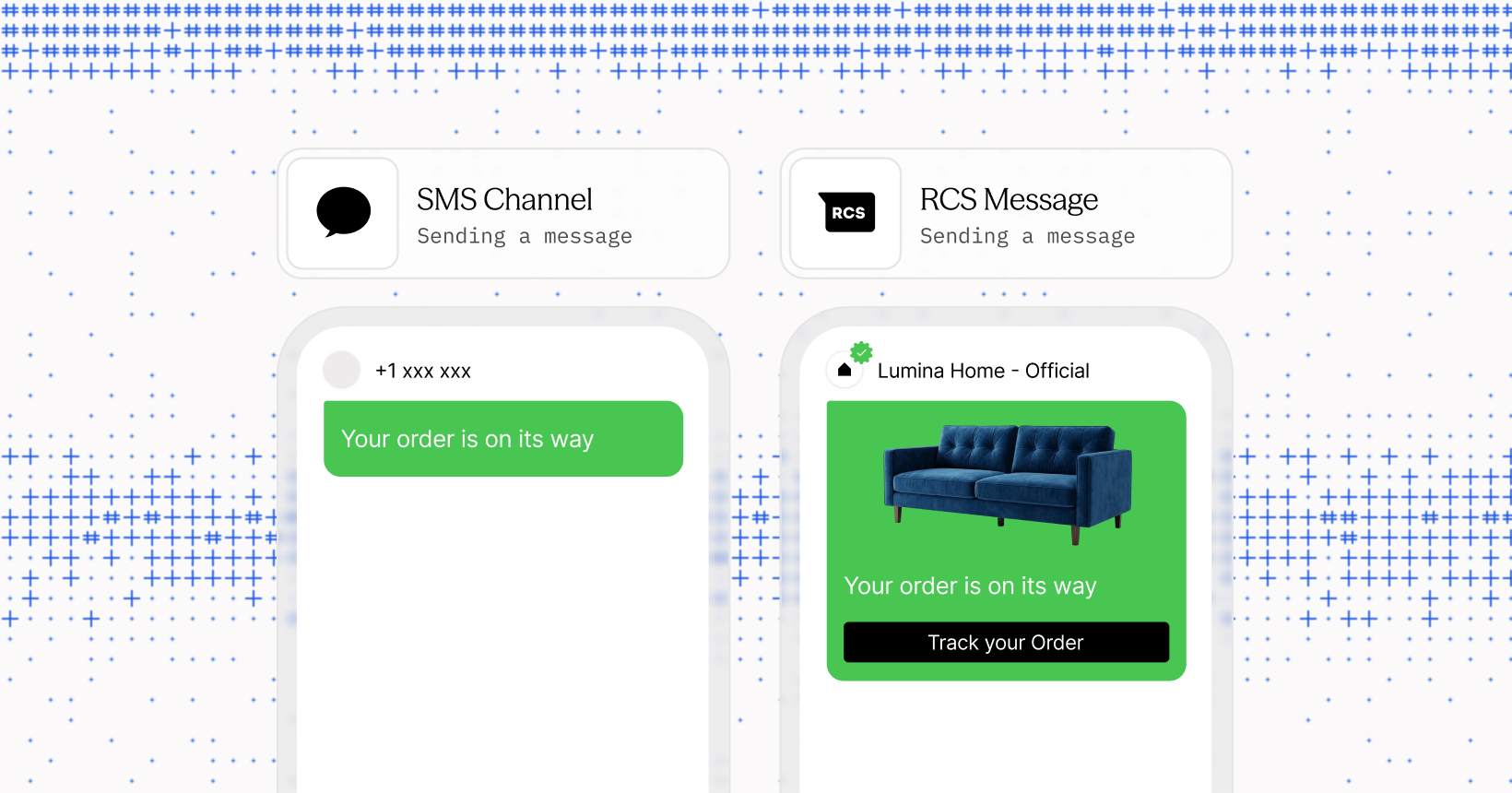
SMS is primarily text-based, while RCS supports richer media experiences. Businesses can use images, videos, and other media to present products, offers, services, or information in a more visual format, and RCS Business Messaging also supports rich cards containing media, text, and suggested actions.
Instead of sending "New summer collection available. Shop now: example.com," an RCS message could present a product image, a description, and an action that takes the customer straight to the relevant page.
Read receipts and typing indicators
RCS read receipts and typing indicators give both sides more visibility into a conversation — particularly useful for conversational business messaging, where customers expect something closer to a modern chat app than traditional SMS.
Suggested actions and replies
RCS can also make messages actionable. A business could provide options to:
- Open a website
- Call a business
- View a location
- Add an event to a calendar
- Continue a conversation
Google's RCS for Business documentation supports suggested replies and actions within rich cards and messaging experiences. How RCS for Business works
Rich cards and carousels
RCS can combine media, text, and actions into rich cards, and multiple cards can also be presented as a carousel — letting customers browse different products, services, or options right inside the conversation. This can be useful for businesses that want to move beyond a single promotional message.
RCS vs SMS for business messaging
The differences become particularly important once messaging is used for more than simple notifications.
SMS is useful for simple messages
SMS can be a practical choice when the message is primarily informational. Examples include:
- One-time passwords
- Delivery notifications
- Appointment reminders
- Account alerts
- Simple confirmations
- Short updates
If the customer only needs to receive a piece of information, the simplicity of SMS can be an advantage.
RCS is useful for richer customer experiences
RCS becomes more interesting when the business wants customers to see, interact with, or act on the message. Examples include:
- Product promotions
- Product recommendations
- Rich offers
- Appointment booking
- Customer support
- Travel information
- Retail campaigns
- Interactive notifications
RCS Business Messaging is specifically designed to support richer media, suggested actions, and conversational interactions between businesses and customers.
Is RCS better than SMS?
There isn't a single answer to whether RCS is better than SMS. It depends on what the business is trying to accomplish. If the goal is to send a short, straightforward notification, SMS may be sufficient. If the goal is to create a visual, branded, or interactive experience, RCS provides capabilities that SMS does not.
SMS is reach and simplicity. RCS is richer experiences and interaction.
That doesn't mean every SMS campaign should become an RCS campaign. The right choice depends on the message, the audience, the market, and the capabilities available to the recipient.
Should I use RCS or SMS?
For businesses deciding between RCS and SMS, start with the customer experience you want to create.
Use SMS when:
- The message is primarily text.
- The customer doesn't need to interact with the message.
- You are sending a simple notification or alert.
- You need a straightforward messaging experience.
Consider RCS when:
- Visual content is important.
- You want to showcase products or offers.
- Customers need to choose between multiple actions.
- Branding inside the messaging experience matters.
- You want customers to interact with a business directly through the conversation.
In many cases, the decision doesn't have to be RCS or SMS. A business messaging strategy can use both, depending on the message and the recipient's available capabilities.
Can RCS fall back to SMS?
One of the practical considerations when adopting RCS is that not every messaging environment supports every RCS capability. RCS specifications include mechanisms for capability discovery and defined fallbacks — the GSMA's latest Universal Profile specifications continue to address backward compatibility for when richer RCS content needs to fall back to SMS.
This is important for businesses because it means an RCS strategy doesn't necessarily have to assume that every recipient will receive the exact same rich experience. Instead, messaging platforms can account for recipient capabilities and use the appropriate messaging channel.
RCS vs SMS: which is right for your business?
The choice ultimately comes down to the type of customer interaction you want to create.
| If your goal is... | Consider |
|---|---|
| Send a simple alert | SMS |
| Send a verification code | SMS |
| Send a short notification | SMS |
| Showcase products visually | RCS |
| Create interactive campaigns | RCS |
| Provide suggested actions | RCS |
| Create richer branded experiences | RCS |
| Support conversational customer journeys | RCS |
| Combine broad messaging with richer experiences | RCS + SMS |
The important point is that RCS isn't simply a replacement for SMS. It gives businesses another set of capabilities for situations where traditional text messaging isn't enough. And as RCS continues to evolve, the distinction between basic messaging and richer conversational experiences is likely to become increasingly important. The GSMA's 2026 Universal Profile 4.0 and 4.1 releases have continued adding capabilities around richer media, business messaging, interoperability, and security.
RCS vs SMS FAQs
What is the difference between RCS and SMS?
SMS is primarily a text-based messaging service, while RCS supports richer media and interactive capabilities such as read receipts, typing indicators, rich cards, and suggested actions.
Is RCS better than SMS?
Neither is universally better. SMS can be appropriate for simple notifications and text-based communication, while RCS provides additional capabilities for businesses that need richer and more interactive messaging.
Should I use RCS or SMS?
Consider SMS for straightforward text-based communications and RCS when visual content, branding, or customer interaction is important. Businesses can also use both, depending on the use case and recipient capabilities.
Will RCS replace SMS?
RCS expands the capabilities available for mobile messaging, but that doesn't necessarily mean SMS disappears. SMS remains relevant for simple communications and situations where RCS capabilities aren't available.