NewsPress Release
Sent raises $12M Series A to supercharge AI messaging infrastructure
An oversubscribed $12 million round led by Companyon Ventures, as Sent moves from software vendor to licensed telecom infrastructure.
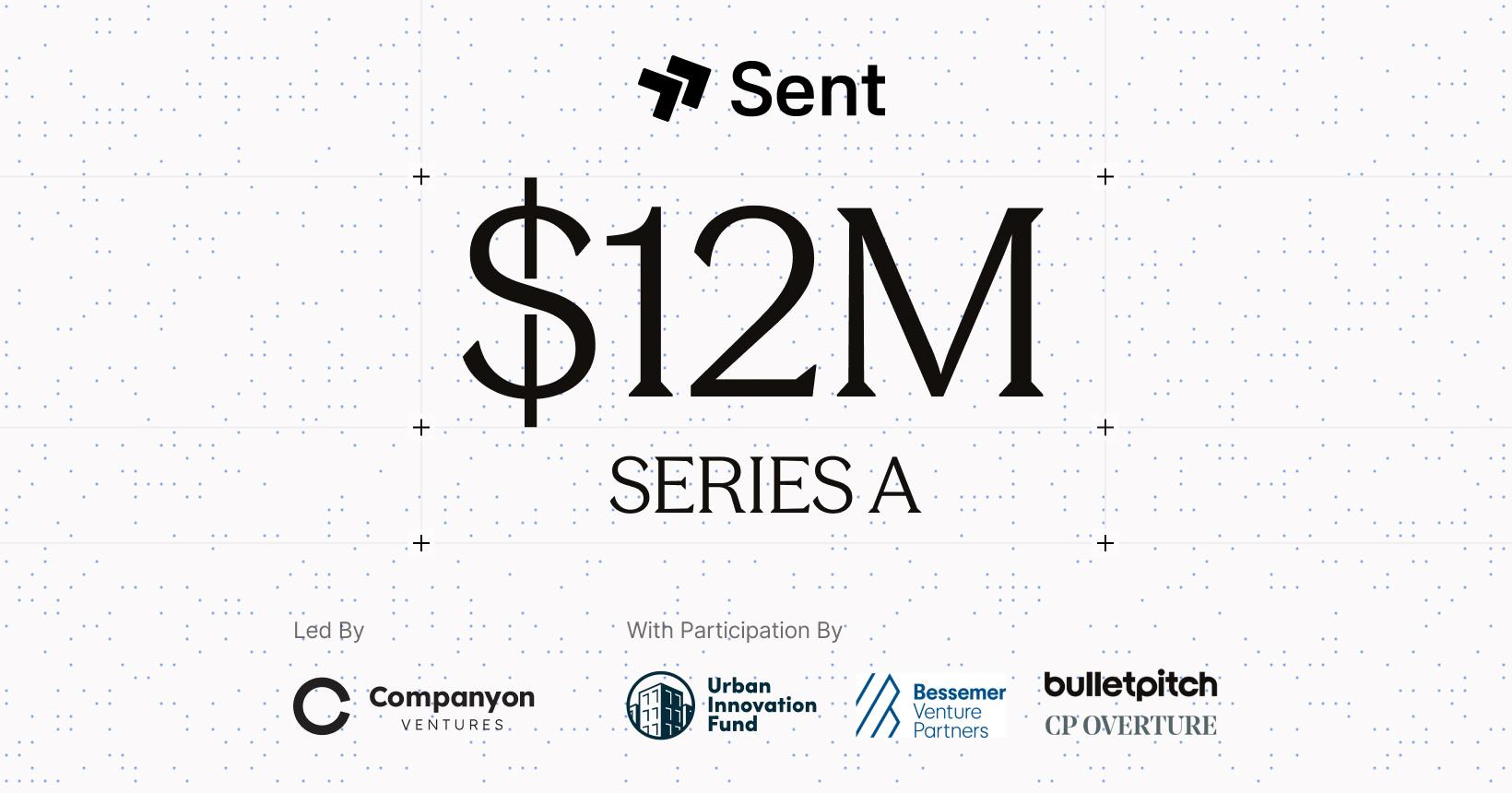
An oversubscribed $12 million round led by Companyon Ventures, as Sent moves from software vendor to licensed telecom infrastructure.

Markets Insider carries the announcement of Sent's oversubscribed Series A, led by Companyon Ventures.
Yahoo Finance carries the announcement of Sent's oversubscribed Series A, led by Companyon Ventures.

Dealroom covers the round and where Sent sits in a messaging market built for the AI agent era.
One API. Every channel.
Contact Sales
NEW YORK, July 28, 2026 — Sent, the unified API that lets companies reach any user over SMS, WhatsApp or RCS through a single integration, today announced an oversubscribed $12 million Series A. The round was led by Companyon Ventures with participation from Bessemer Venture Partners, UIF and CP Overture, among others. Companyon, Bessemer and UIF all invested in Sent's earlier rounds and are now tripling down as the company moves from software vendor to licensed telecom infrastructure. Angel investors from Clay, Eleven Labs and Attentive invested at the pre-seed stage.
The global A2P messaging market is worth approximately $100 billion and dominated by legacy vendors like Twilio, Sinch and Infobip. These incumbents are unprepared for the wave of agentic messaging that will soon see AI agents sending more messages than humans.
Enter Sent: modern messaging infrastructure built for AI-native products.
Built by developers who lived the problem
Sent's co-founders, Daniel Vataj and Betim Drenica, spent years building software that depended on messaging and kept hitting the same walls every developer knows. Verification codes that silently failed. A separate integration, compliance regime and vendor contract for every channel. Deliverability problems no dashboard could explain, let alone fix.
The frustration turned personal when Daniel was locked out of his own bank account while travelling internationally after a one-time verification code sent by SMS never arrived. The fix was obvious: the message should have fallen back to WhatsApp, but it never did. Betim had experienced similar issues.
Rather than treat that as an isolated failure, they set out to rebuild messaging deliverability at the infrastructure level.
The problem, they concluded, was the infrastructure underneath, not the tooling on top. So they founded Sent to rebuild it, building an AI model that determines two things in real time: what's available (which platforms can actually receive a message to this number) and what's optimal (if the number is reachable on WhatsApp, SMS, and RCS, send to the one they actually use).
Sent at a glance
Legacy infrastructure, rebuilt for a channel-native world
Legacy providers like Twilio, MessageBird and Sinch were built around SMS as the default channel, an assumption that no longer holds. Only 13% of consumers now use SMS as their primary messaging channel, yet brands still spend an average of $0.11 per message reaching customers through it, and every new channel means a separate integration, a separate compliance regime and a separate campaign to rebuild.
Sent's API abstracts all of it: write once, and the platform automatically routes each message to the channel most likely to reach that specific recipient, handling content formatting, carrier relationships and compliance (including TCR and 10DLC) behind the scenes.
Investor perspectives
Proof in production
Companies including TrimRX, ITM Studio and ITNIO Tech have moved off Twilio and onto Sent.
From software vendor to regulated infrastructure
Sent recently became a licensed telecom carrier in the United States, a designation that moves the company from a vendor sitting on top of existing carrier infrastructure to a direct participant in it, with the ability to allocate numbers directly and regulatory and technical parity with incumbents.
Sent's team draws the comparison to Stripe's evolution from a checkout widget into a payments processor, or Plaid's move from developer tool to regulated financial infrastructure: the moment a company stops being a better interface and becomes the system of record underneath it.
That shift matters most for AI. As software agents increasingly initiate customer conversations (sending confirmations, resolving support issues, closing transactions), messaging is becoming two-way, persistent and agent-driven rather than a one-off notification. Sent's platform is built for that world: a durable user identity that persists across sessions and channels, MCP-compatible tooling for agent developers, and rate-aware delivery designed to keep automated workflows from breaking under load.
Use of funds
The Series A will fund continued expansion of Sent's direct carrier network, deepen its AI-native, agent-facing messaging infrastructure, and grow its engineering, compliance and enterprise go-to-market teams as the company moves further upmarket.
About Sent
Sent is the unified messaging API for modern software companies, letting them reach any user over SMS, WhatsApp or RCS through a single integration. Sent's platform automatically routes every message to the channel most likely to deliver it, manages compliance across 75-plus carrier integrations globally, and reaches more than 1 billion phone numbers with mapped channel preferences. Sent is a licensed telecom carrier in the United States and is SOC 2 Type 2 compliant. The company is backed by Bessemer Venture Partners, Companyon Ventures and Urban Innovation Fund (UIF). Learn more at sent.dm.
Contacts
Media contact: Steel Comms for Sent, ant@steelcomms.co
Investor contact: Daniel Vataj, co-founder and CEO, investors@sent.dm